<?xml version="1.0" encoding="utf-8"?><feed xmlns="http://www.w3.org/2005/Atom" ><generator uri="https://jekyllrb.com/" version="4.4.1">Jekyll</generator><link href="https://blakebyer.github.io//feed.xml" rel="self" type="application/atom+xml" /><link href="https://blakebyer.github.io//" rel="alternate" type="text/html" /><updated>2025-09-17T01:02:56+00:00</updated><id>https://blakebyer.github.io//feed.xml</id><title type="html">Blake Byer</title><subtitle>This is the personal webpage of Blake Byer.</subtitle><author><name>Blake Byer</name><email>bbyer04@gmail.com</email></author><entry><title type="html">The Birthday Paradox</title><link href="https://blakebyer.github.io//blog/2025/07/31/probabilityintro.html" rel="alternate" type="text/html" title="The Birthday Paradox" /><published>2025-07-31T00:00:00+00:00</published><updated>2025-07-31T00:00:00+00:00</updated><id>https://blakebyer.github.io//blog/2025/07/31/probabilityintro</id><content type="html" xml:base="https://blakebyer.github.io//blog/2025/07/31/probabilityintro.html"><![CDATA[<p>Consider the question, how many people must be a room such that the probability of at least two will share a birthday exceeds 50%?</p>

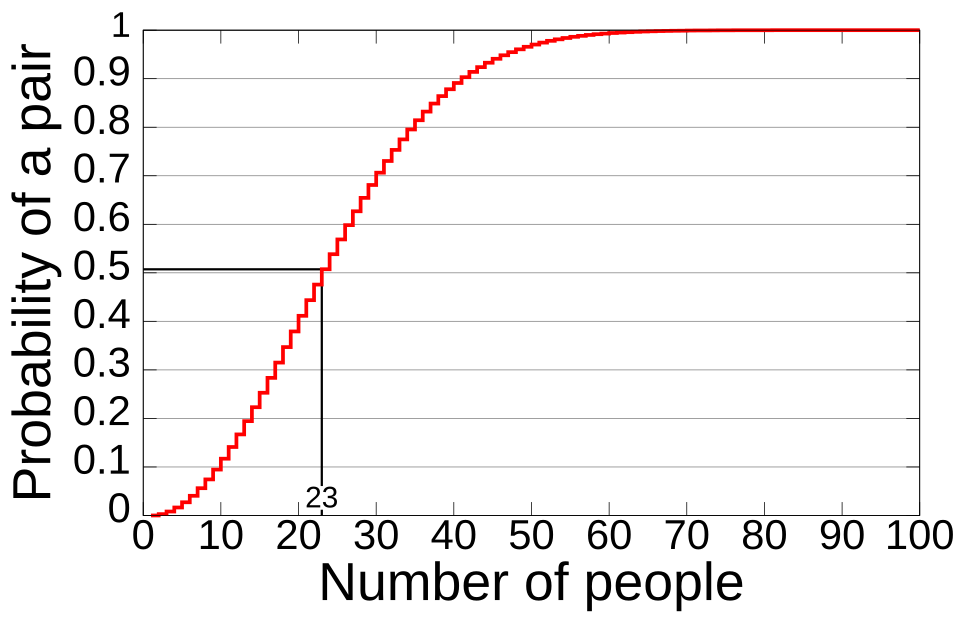
<p>You might guess about 182 because it’s about half the days in a year, or 100 because it’s a nice round number. However, the answer might surprise you.</p>

<p>The correct answer is just 23 people. How can this be true?! The answer lies in probability theory. Let the event A be that of a group of k people not having any repeated birthdays, and let B be that of a group of k people having at least two who share a birthday, i.e. \(P(B) = 1 - P(A)\).</p>

<figure>
  <img src="/assets/images/Birthday_Paradox.png" alt="Birthday paradox" />
  <figcaption><em> The probability function of the birthday problem P(B) for n people. Illustration by Rajkiran g, CC BY-SA 3.0 via Wikimedia Commons.
  </em></figcaption>
</figure>

<p>To calculate the number of k persons to exceed 50% one technique we might use is to decrement the number of possible shared birthdays for \(n+1\) people. For person 1 there is 100% chance they don’t share their birthday with another person, when adding person 2, there is a \(\frac{364}{365}\) chance they don’t share their birthday with person 1, and this continues as a conditional probability until you reach &gt;50%.</p>

\[P(A)= \frac{365}{365} \times \frac{364}{365} \times \cdots \times \frac{343}{365} \approx 0.493\]

\[\therefore P(B) \approx 1 - 0.493 = 0.507\]

<p>A more concise way of representing this is the probability function \(\bar{p} = \frac{365!}{365^n(365-n)!}\). An approximation to try (that doesn’t require numerical methods) is \(n\geq \frac{1}{2} + \sqrt{\frac{1}{4} + 2\times\ln{2}\times 365}\).</p>

<p>I hope you liked this introduction to probability with the Birthday Paradox. Stay curious!</p>

<!-- A quick refresher on combinations and permutations. The number of combinations (order doesn't matter) of n choose r is $$C(n, r)= \frac{n!}{r!(n-r)!}$$ where $$!$$ is the factorial operator (e.g. $$4! = 4\times 3\times 2\times 1 = 24$$). Similarly, the number of permutations (order does matter) is $$P(n, r) = \frac{n!}{(n-r)!}$$. For both of these formulas, $$n$$ is the number of total objects, and $$r$$ is the number of objects chosen at once. 

## Conditional Probability ##
Conditional probability is the probablity of one thing happening given that another event has already occurred. 

## Joint Probability ##
Joint probability is the probability of two or more events occurring simultaneously. -->]]></content><author><name>Blake Byer</name><email>bbyer04@gmail.com</email></author><category term="blog" /><summary type="html"><![CDATA[How many people must be in a room such that the probability at least two sharing a birthday exceeds 50%?]]></summary></entry><entry><title type="html">GLBIO 2025</title><link href="https://blakebyer.github.io//blog/2025/05/15/glbio25.html" rel="alternate" type="text/html" title="GLBIO 2025" /><published>2025-05-15T00:00:00+00:00</published><updated>2025-05-15T00:00:00+00:00</updated><id>https://blakebyer.github.io//blog/2025/05/15/glbio25</id><content type="html" xml:base="https://blakebyer.github.io//blog/2025/05/15/glbio25.html"><![CDATA[<p>I spent last week in Minneapolis, Minnesota at the International Society for Computational Biology Great Lakes Bioinformatics Conference, aptly named
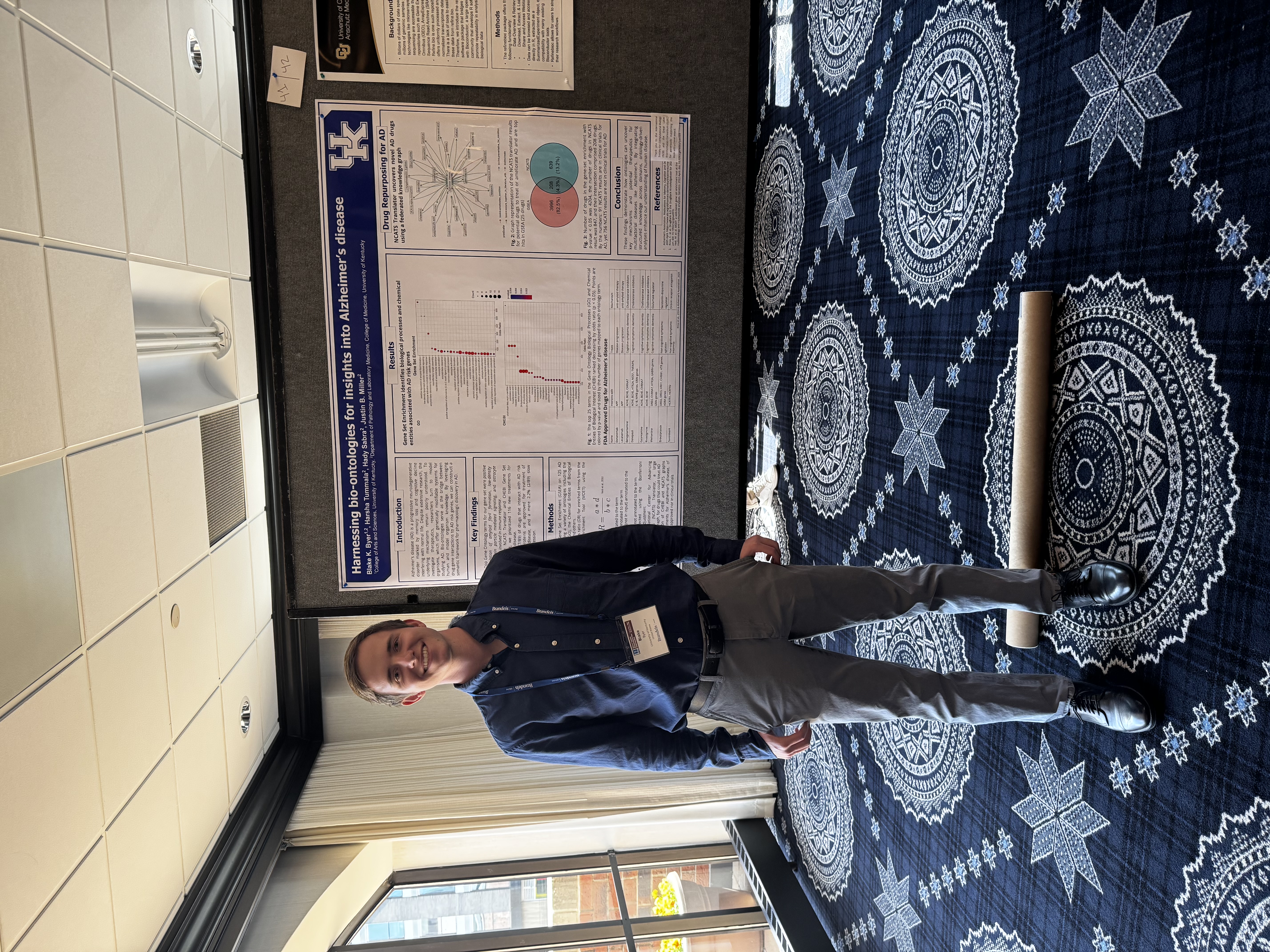
GLBIO 2025. I presented a poster on Alzheimer’s disease drug repurposing using multi-ontology enrichment analysis, with an a priori gene set derived 
from AD GWAS. Using this method I prioritized approximately 100 FDA-approved repurposable drugs and I discovered that 7 out of 89 (8%) FDA-approved drugs interacting
with AD risk genes are used to treat AD, suggesting ample repurposing opportunities!</p>

<p>Since this project was very brief, plenty of work needs to be done to improve the pipeline, incorporating molecular and pharmacokinetic simulations (TBD).</p>

<!-- Jekyll Ideal Image Slider Include -->
<!-- https://github.com/jekylltools/jekyll-ideal-image-slider-include -->
<!-- v1.8 -->
<link rel="stylesheet" href="/assets/css/slider/ideal-image-slider.css" />

<link rel="stylesheet" href="/assets/css/slider/themes/default.css" />

<style>
  .slider {
    margin-bottom: 1.5rem;
  }
</style>

<!-- Jekyll Ideal Image Slider Include -->
<!-- https://github.com/jekylltools/jekyll-ideal-image-slider-include -->
<!-- v1.8 (Modified for DOM-safe initialization) -->
<div id="slider-2025-05-15" class="slider"><img src="/assets/images/fogodechao.jpg" alt="" title="From left to right: Justin Miller, Elisandra Miller, Ollie Miller, Blake Byer, Mark Ebbert." /><img src="/assets/images/blake_poster.jpg" alt="" title="At my poster, presented Tuesday, May 13th." /><img src="/assets/images/weisman.jpg" alt="" title="The Weisman Art Museum, a Frank Gehry building, on University of Minnesota&#39;s campus." /></div>

<script>
    document.addEventListener('DOMContentLoaded', function () {
      if (typeof IdealImageSlider !== 'undefined') {
        var slider = new IdealImageSlider.Slider({
          selector: '#slider-2025-05-15',
          height: '300px',
          effect: 'fade',
          interval: 4000,
          transitionDuration: 1000,
          captions: true,
          bullets: false
        });

        
        slider.addCaptions();
        slider.start();
      } else {
        console.warn("⚠️ IdealImageSlider is not defined — slider won't start.");
      }
    });
  </script>

<!-- Ideal Image Slider JS via CDN -->
<script src="https://cdn.jsdelivr.net/npm/ideal-image-slider@1.5.1/ideal-image-slider.min.js"></script>

<script src="https://cdn.jsdelivr.net/npm/ideal-image-slider@1.5.1/extensions/bullet-nav/iis-bullet-nav.min.js"></script>

<script src="https://cdn.jsdelivr.net/npm/ideal-image-slider@1.5.1/extensions/captions/iis-captions.min.js"></script>

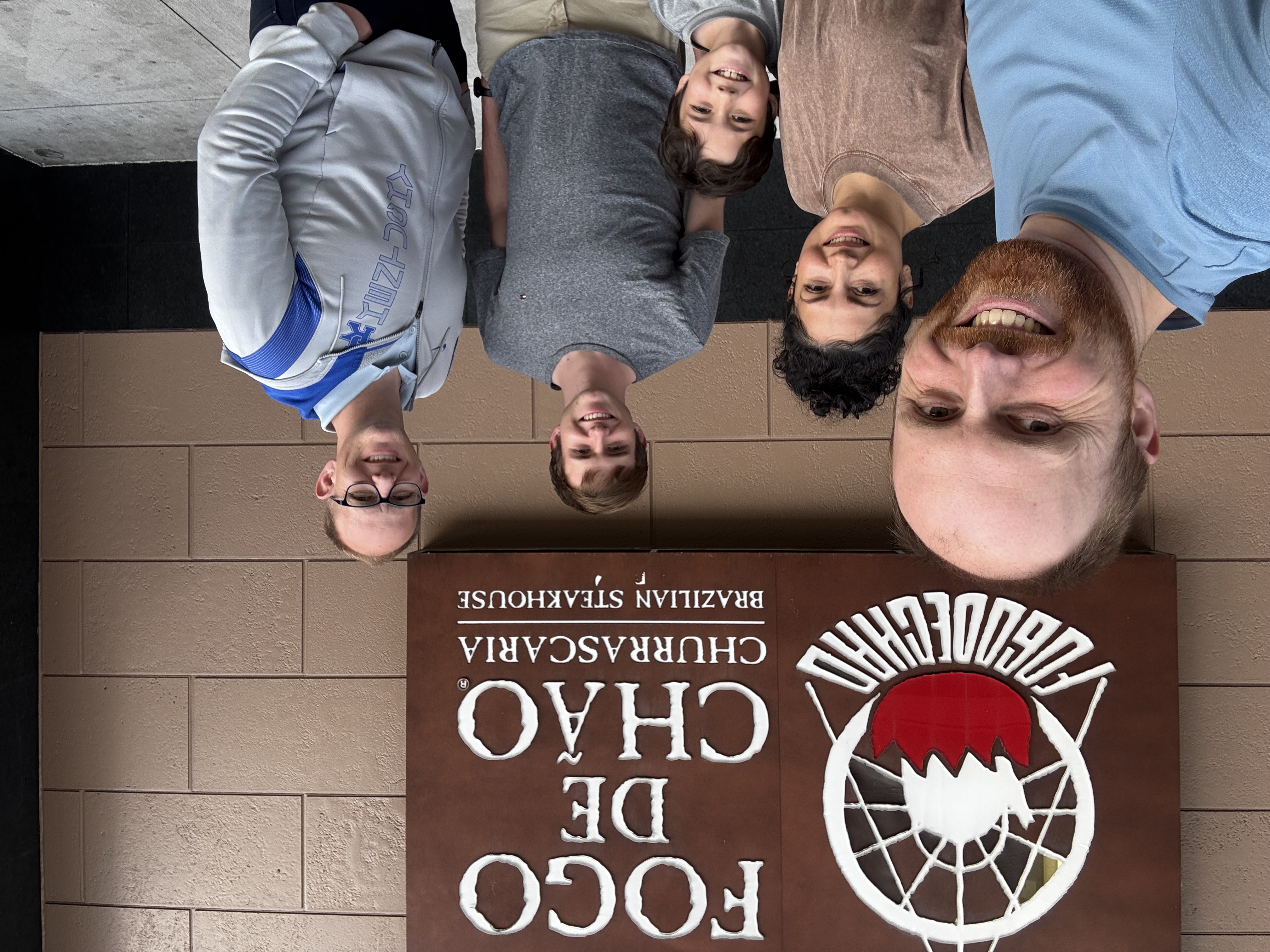
<p>On Wednesday, May 14th, we went to Fogo de Chão, a brazilian steakhouse, in downtown Minneapolis. I ate way too much food and drank too much limeade!</p>

<p>To conclude the conference, my mentor Justin Miller and collaborator Mark Ebbert presented on our work benchmarking SegmentNT, a nucleotide transformer 
model. We showed there are several biases impacting model reliability, such as variable exonic probability depending on the nucleotide’s position in the input 
sequence (first, middle, last), as well as apparent cyclic oscillations every 24 n.t. in the output. These findings could be applicable to all nucleotide 
transformer models like DNABERT or HyenaDNA, perhaps due to 6-mer tokenization during training. Our preprint is out on <a href="https://www.biorxiv.org/content/10.1101/2025.04.09.647946v1.full">bioRxiv</a> and under review at Nucleic Acids Research.</p>

<p>I met lots of great people at GLBIO 2025. Shout out to Stephen, Amanda, Garrett, and Harrison all of BYU, and Dionizije and Mateo of Entropic! Science can bring people across
the world together, from Provo, Utah to Zagreb, Croatia.</p>]]></content><author><name>Blake Byer</name><email>bbyer04@gmail.com</email></author><category term="blog" /><summary type="html"><![CDATA[The real treasure are the friends we make along the way]]></summary></entry></feed>